


What is Abrasion Resistant CCO Steel Plate
Abrasion Resistant CCO Steel Plate is formed by surfacing welding on ordinary steel plate, heat-resistant steel plate, and stainless steel plate with a volume fraction of 50% The above alloy wear-resistant plates mainly composed of Cr7C3 carbides.Product process of Abrasion resistant CCO steel plate: through carbon electrode arc and special equipment for surfacing welding, it is made by surfacing Cr7C3 carbide on the surface of ordinary steel plate or heat-resistant steel plate and stainless steel plate, and can be produced in different thicknesses according to customer requirements and different working conditions.
why choose us
Quality Control
For each process,we have strict inspection standards,and we always insist that quality is life.
Competitive Price
We have a professional purchasing team and costing team,trying to reduce costs and profits,and provide you with a good price.
Quality customer service
Our dedicated team is always ready to answer your questions, provide you with detailed information about our products and guide you in your choice.
Fast and reliable delivery
We understand the importance of receiving your orders as soon as possible. Whether you are in France or in Europe, you can count on us for fast and reliable delivery.


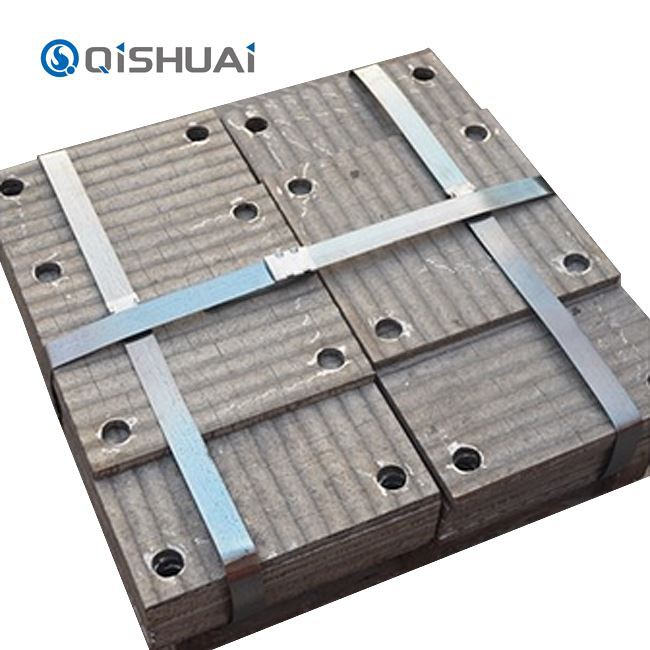


Benefits of Abrasion Resistant CCO Steel Plate
High wear resistance
The thickness of the wear-resistant layer of Abrasion Resistant CCO Steel Plate is 3-12mm, and the hardness of the wear-resistant layer can reach HRC58-62. The wear resistance of abrasion resistant steel plate is more than 15-20 times that of ordinary steel plate, 5-10 times that of low-Alloy steel plate, and 2-5 times that of high-chromium cast iron.
Good impact performance
The Abrasion Resistant CCO Steel Plate is a double-layer metal structure. The wear-resistant layer is metallurgically combined with the base material, and the bonding strength is high. Abrasion resistant steel plate absorbs energy during the impact, and the wear-resistant layer will not fall off. Abrasion resistant steel plate is suitable for working conditions with strong vibration and impact.
Good temperature resistance
The alloy carbides of Abrasion Resistant CCO Steel Plate have strong stability at high temperatures. Abrasion resistant steel plate can be used within the range of 500°C, and other special requirements can be customized, and can be used at 1200°C. Wear-resistant materials such as ceramics, polyurethane, and polymer materials cannot meet such high-temperature requirements.
Good connection performance
The base material of Abrasion Resistant CCO Steel Plate is ordinary Q235 steel plate, which ensures the toughness and plasticity of abrasion resistant steel plate and provides the strength to resist external forces.
What are the Applications of Abrasion Resistant CCO Steel Plate
Construction
Abrasion Resistant CCO Steel Plate are used to strengthen various structures. For example, they can be used to strengthen bridges by being bonded to the beams. Steel plates are also commonly used when constructing foundations, skyscrapers or large buildings, airports, and more.
Transportation
Seeing as any form of transportation needs to be very strong to be safe, it's no wonder that steel plates are commonly used in them. Steel plates are used for many cars you might see on the road, although they're more commonly used in military transports like tanks, ships, helicopters, and trucks.
Appliances
Abrasion Resistant CCO Steel Plate are used in many everyday appliances. For example, metal plates can help keep the contents of your refrigerator cold by cooling the air.
Wear-Resistant Cco Steel Plates Usually Use The Following Two Welding Methods

Joining Welds
Which retain the CCO plate to the base plate of the equipment. Joining welds are not as hard as the Chrome Carbide, and abrasion can rapidly wear away the joining weld deposit.
Hardfacing Welds
These join nothing. The only purpose of a hardfacing weld is to cover or 'Cap' the joining weld. This protects the weld from wear in the same way as a hat protects your head from the rain.

In general, plates are classified as thick plates when the minimum dimension to thickness ratio (b/h) is less than 10, thin plates when the b/h ratio ranges from 10 to about 100, provided that the plate maximum deflection to thickness ratio (w/h) is less than 0.2, and membranes when the b/h ratio approaches 100 and w/h ≥0.2. Thick plates develop internal stress resultants governed by three-dimensional elasticity similar to that of a solid body. Thin plates behave as plane stress members governed by two-dimensional elasticity. Membranes can only develop internal tensile stress within the plate's neutral plane. Few studies have adopted b/h ratios between 90 and 110 to investigate the feasibility of the utilization of such plates in their various available forms. The current study with the b/h ratio of 100 aims to fill the gap.
Abrasion resistant CCO steel plate are available in different forms such as intact plates, stiffened, perforated, and stiffened perforated plates. They are used in buildings, bridges, ships, as well as aerospace structures. In this study, the investigated steel plate has a square shape and is subjected to uniaxial loading. The plate edges are simply supported. The plate is 200 mm wide and 2 mm thick. In this case, the critical buckling strength is, in general, less than the plate maximum strength. With further loading, the plate would experience an undesirable sudden mode of failure owing to buckling instability. This study aims at investigating the performance of the different forms of square steel plates, such as intact, stiffened, perforated, and perforated stiffened, when the minimum dimension to thickness ratio is 100. A pushover finite element linear elastic buckling analysis as well as a nonlinear large deflection buckling analysis have been carried out.
Process of Abrasion Resistant CCO Steel Plate
Step 1: Steel cutting: In this step, the steel plates will be cut into the shapes and dimensions specified in the technical drawings.
Step 2: Welding: After being positioned and temporarily assembled with welding, the steel components are placed into an automatic welding machine. To ensure that the welding is done correctly and of the highest quality, the weld bead must first be visually inspected for surface imperfections. Then, the quality of the weld is checked using ultrasonic testing or magnetic particle inspection methods.thiếu link xem thêm
Step 3: Adjusting: During the welding process, high temperatures can cause the components to warp. Therefore, to ensure that the components are highly accurate during installation, they need to be adjusted, straightened, and inspected before proceeding with the next steps.
Step 4: Welding of reinforcing ribs: After the components have been welded and precisely adjusted, the construction of the reinforcing ribs and cleats is also carried out using welding. This is a crucial step in the process of structural steel fabrication, performed by skilled workers to ensure maximum accuracy.
Step5: Shot blasting cleaning: The processed components need to undergo surface treatment to remove water stains, oil, grease, and other impurities. In this step, the steel components will be cleaned by surface rust removal and treated with shot blasting machines. Afterward, they will be prepared for the painting process and final finishing touches.
Step 6: Coating: During the processing and use of structural steel, a high-quality coating of paint will protect the steel components from the effects of the surrounding environment, greatly influencing their durability and lifespan. Typically, the surface of the components will be coated with one layer of anti-corrosion paint and two layers of paint in the desired color according to the customer's requirements.
How to Choose Abrasion Resistant CCO Steel Plate
Now it is time to hone-in on the proper steel plate grade. Steel plate is available in various grades, each designed to meet specific performance requirements.
Determining the correct plate weight, size, and thickness helps to ensure structural stability and safety. Evaluate the load and stress factors to which the steel plate will be subjected. Consider the dimensions of the area where the plate will be installed. Consider any weight limitations or space restrictions. Ensure that the thickness of the steel plate is adequate to withstand the anticipated loads without compromising structural integrity.
In certain applications, specialized CCO Steel Plate may be required. These can include high-temperature applications, corrosive environments, or situations demanding specific certifications such as ABS (American Bureau of Shipping) or ASTM (American Society for Testing and Materials). Another specification to consider is ASME (American Society of Mechanical Engineers). This is particularly relevant for tank and pressure vessel applications.
Request samples of the steel plates you are considering. Examine their physical properties, test them for quality assurance, and assess their suitability for your application.Ask your steel supplier to supply you with test reports and certifications, such as material composition, mechanical properties, and any tests conducted. Please note that a steel test report will not be available in every instance. These reports are contingent upon the producing steel mill.
Choosing a reputable steel supplier is essential with any steel purchase. Beyond having a broad catalog of options, your steel plate supplier should have a proven track record of helping customers navigate the aforementioned five factors.
How to Maintain Abrasion Resistant CCO Steel Plate

2000
Cleaning and maintenance
Steel plates are easily affected by pollutants and moisture. If not cleaned in a timely manner, it can lead to rust spots and corrosion on their surface. Therefore, proper cleaning and maintenance are important steps in protecting steel plates.

2005
Cleaning
Rinse the board surface with clean water and clean stains and dirt with neutral detergent. Be careful not to use cleaning agents containing chlorides or hard substances. When cleaning, you can use a soft brush or sponge to gently wipe the surface of the board.

2008
Drying
Use a clean towel or cloth to dry the surface of the board and ensure that the surface is completely dry. Be careful not to leave any residual moisture on the surface of the steel plate, otherwise it will accelerate the corrosion of the steel plate.

2010
Anti-corrosion treatment
Steel plates are prone to moisture and oxidation, especially in humid environments where they are more prone to rusting. Therefore, before installing the steel plate, it should be treated with anti-corrosion to extend its service life.

2012
Coating
Coating with anti rust paint or other anti-corrosion coatings can provide anti-corrosion effects. Different coatings are suitable for different environments and needs, and appropriate coatings should be selected based on specific circumstances.

2014
Hot dip galvanizing
Hot dip galvanizing is a commonly used anti-corrosion treatment method with good anti-corrosion performance. The principle is to form a layer of zinc on the surface of the steel plate to protect it.

2017
Regular inspections
Even if sufficient maintenance measures are taken, steel plates still require regular inspection and maintenance. This helps to promptly identify and solve problems with the steel plate, thereby maintaining its good condition.
Our Factory

Shandong Qishuai Wear-resistant Equipment Co., Ltd. is a manufacturing enterprise integrating R & D, manufacture and installation. It is an experienced manufacturer specializing in providing wear-resistant technical solutions and supporting wear-resistant products.Our factory is located in zibo city and it covers more than 2500 square meters.Include 2 workshops.Alumina ceramic and wear resistant chromium carbide plates.The factory has advanced processing equipment and experienced technical staff.We adhere to the way"the quality is the first" and we has won praise at home and abroad.


FAQ
Hot Tags: abrasion resistant cco steel plate, China, manufacturers, suppliers, factory, wholesale, price, cheap, for sale, Shandong Qishuai, Rubber Ceramic Impact Lining, Wear Resistant 92 Al2o3 Ceramic Tube, High Impact Resistance Ceramic Liner, Ceramic Rubber Lining Wear Plates, Ceramic Rubber back lining plate, Alumina Ceramic